
Rotary can fillers move cans around a rotating turntable continuously, while linear isobaric can fillers transport cans along a straight conveyor track. All filling stations are arranged in a line. Cans stop at each station to finish the filling process step by step. This type of machine is widely used in small and medium craft breweries, with easy adjustment for different can sizes.
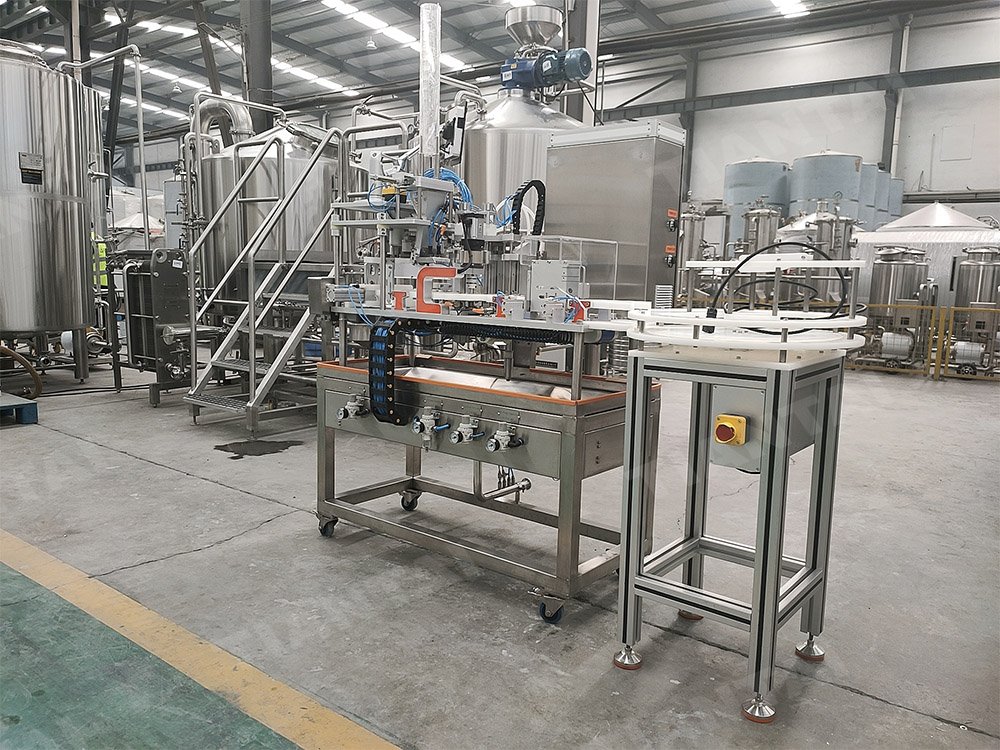
The core principle stays the same as rotary isobaric filling. Beer contains plenty of dissolved CO₂. If exposed to normal pressure directly, CO₂ will escape rapidly and cause heavy foaming, overflow and flavor loss. The machine equalizes pressure first to minimize foam and oxygen pickup, protecting beer taste and shelf life.
Here is the full working sequence. First, can feeding and positioning. Clean empty cans travel on the linear conveyor. Stoppers hold cans in place and align them exactly under filling heads. Multiple filling valves work at the same time to fill a group of cans together. A no-can-no-fill function is equipped to avoid beer waste and CO₂ loss.
Second, CO₂ pre-purging. The filling head descends and seals tightly with the can mouth to form a closed space. Food-grade CO₂ is injected to sweep out original air inside the can. Most craft can fillers support one or two purging cycles to cut residual oxygen. Can filling usually adopts direct CO₂ purging, vacuum pre-pumping is less common for cans.
Third, backpressure charging and pressure equalization. More CO₂ is filled into the can until the internal pressure matches the pressure inside the beer tank. This is the key isobaric step. Once pressures are balanced, beer can flow in without violent bubbling.
Fourth, beer feeding and gas return. The liquid valve opens, and beer flows gently along the inner can wall instead of hitting the bottom. As the liquid level rises, displaced CO₂ flows back to the gas space of the beer tank through the return pipe to keep stable pressure. Filling stops automatically once the liquid covers the end of the return pipe. The liquid level is controlled by the height of the return tube, so every can gets the same volume of beer. All valves in one group act synchronously with the same filling time setting.
Fifth, slow pressure release (snift). After filling finishes, the liquid valve closes. The high-pressure gas in the top space is released slowly to atmospheric pressure. Fast pressure release will trigger sudden foaming and spillage, which ruins the filling result.
Sixth, head lifting and can discharge. After pressure release, filling heads lift up. Stoppers release the filled cans, and the conveyor sends them forward to the seaming station immediately. Some machines add a foam jet function before sealing. A thin foam layer pushes air out of the top space for lower oxygen intake.
The structure is simple without a large complicated rotary turntable, so it occupies less floor space. It is friendly to small craft breweries. Format change for different can sizes is quick and simple. Each valve group can be adjusted separately, and maintenance is easier. The investment cost is lower, suitable for flexible small-batch production and frequent package switching. The sanitary design is straightforward, and CIP cleaning can be carried out conveniently.
It works in an intermittent mode. Cans stop for filling before moving forward. Its maximum output is much lower than rotary can fillers. With the same number of filling valves, the running speed is slower. It is not suitable for large-scale mass production. Under high-speed operation, pressure stability and filling consistency cannot reach the level of rotary filling machines.
Linear isobaric beer can fillers are perfect for small craft breweries, trial production of new beer recipes, small-batch can runs, and production lines with frequent can specification changes.