
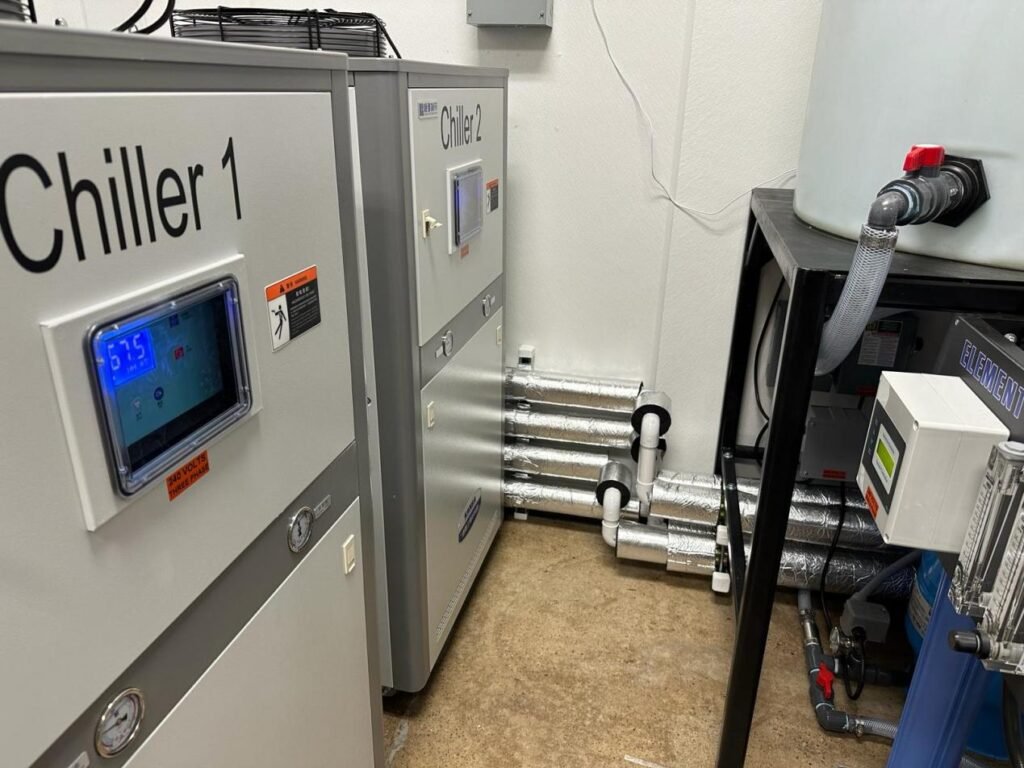
Every craft brewery relies on stable cooling for wort cooling, fermentation temperature control and cold crashing. The core of this cooling system is the chiller. Many brewers know it supplies cold fluid to the glycol water tank, but few understand its working principle. A chiller transfers heat from the glycol loop to the outside environment by refrigerant phase change in a closed cycle.
The refrigeration cycle consists of four key stages: compression, condensation, expansion and evaporation. The refrigerant circulates inside sealed pipes and changes between liquid and gas continuously to move heat.
First comes compression. Low-pressure, low-temperature gaseous refrigerant flows into the compressor. The compressor applies pressure to the refrigerant. With mechanical work, the refrigerant turns into high-pressure, high-temperature gas. Electric energy is converted into heat energy in this process, and the temperature of the refrigerant rises sharply.
Next is condensation. Hot high-pressure refrigerant gas enters the condenser. The condenser is equipped with fans or water cooling structures. Ambient air or cooling water takes heat away from the refrigerant. After releasing heat, the refrigerant condenses into high-pressure liquid. All the extracted heat is discharged outside the brewery, which explains why the chiller releases warm air during operation.
Then the refrigerant passes through an expansion valve. The narrow passage of the expansion valve rapidly reduces the pressure of the liquid refrigerant. Part of the liquid flashes into gas, and the temperature drops dramatically. The refrigerant becomes a low-temperature, low-pressure mixture of liquid and vapor.
The last step is evaporation. The cold refrigerant mixture flows into the evaporator. On the other side of the evaporator is the glycol circulation line. The warmer glycol transfers heat to the refrigerant. The refrigerant absorbs heat and fully vaporizes into low-pressure gas. Meanwhile, the glycol loses heat and cools down. The chilled glycol flows to the glycol water tank, ready for plate heat exchangers and fermenter jackets. The gaseous refrigerant returns to the compressor, and the cycle repeats.
It is important to understand one core idea: a chiller does not create cold. It only moves heat out of the glycol solution.
We need to separate two different tanks in your brewhouse. The cold water tank holds filtered tap water for pre-cooling and heat recovery, and it has no connection with the chiller. The glycol water tank stores propylene glycol solution cooled by the chiller, which forms an independent closed loop and will never mix with wort or brewing water.
The chiller capacity should match your brewhouse output and total fermenter volume. A reliable chiller keeps glycol temperature steady. Stable cooling ensures consistent wort cooling speed and precise fermentation temperature control. Unstable temperature will bring unwanted off-flavors and raise contamination risk for your beer.
A properly sized chiller works together with the glycol water tank, supporting continuous brewing and helping you maintain consistent beer quality batch by batch.