
Many craft brewers feel confused when configuring brewhouse cooling systems. They often wonder about the differences between a cold water tank and a glycol water tank. Both tanks support cooling for wort, yet they carry separate responsibilities in the brewing workflow. They are essential for stable wort cooling, and the right combination directly affects brewing efficiency, energy cost and beer consistency.
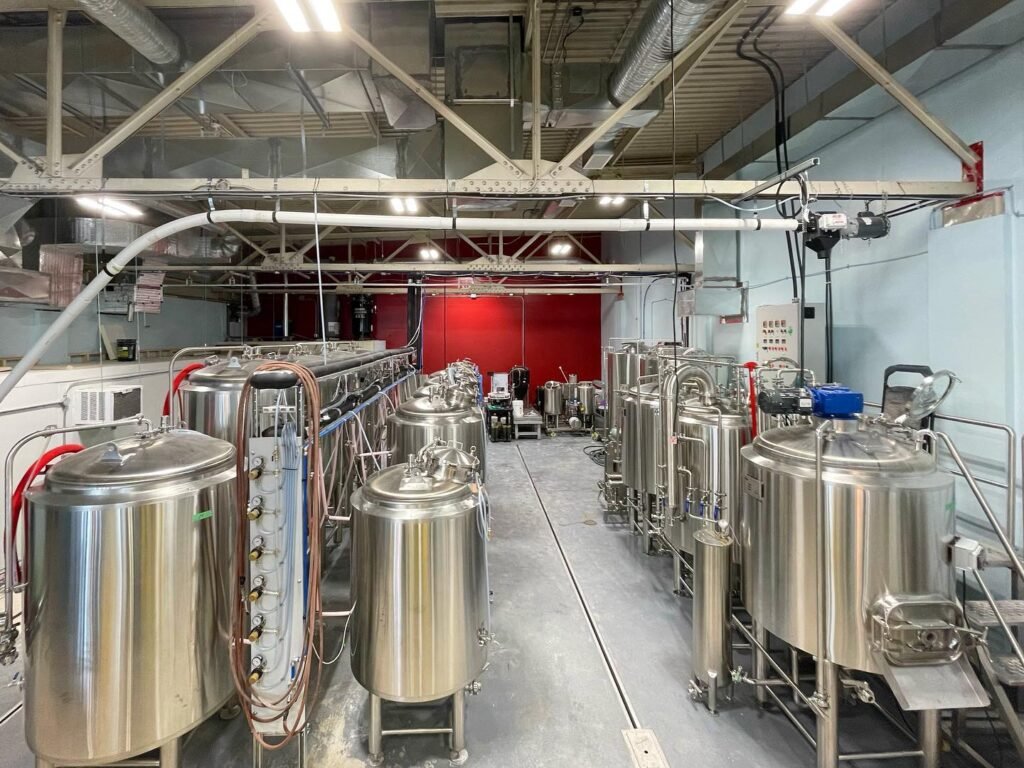
The cold water tank holds filtered brewing water sourced from the plant tap water supply. Importantly, this water does not go through the chiller for temperature reduction. It is mainly designed for two-stage wort cooling.
After boiling, hot wort flows into the first section of the plate heat exchanger. Water from the cold water tank takes away most of the heat and cools the wort down to 40–50°C in the pre-cooling stage. This step greatly cuts the heat load for the chiller system. The chiller does not need to run at full capacity all the time, so brewers can select a smaller chiller unit and save electricity during long-term production.
When the cold water absorbs heat from hot wort, its temperature rises. This warmed water can be recovered and sent to the hot water tank. It can be reused as mash water or sparge water, reducing steam and fuel consumption for the boiler. Heat recovery is one of the most practical ways for breweries to cut running costs.
Besides heat recovery, the cold water tank works as a buffer storage tank. It stabilizes water pressure and flow rate to the plate heat exchanger. Unstable tap water supply will lead to uneven cooling speed, which brings inconsistency to your brewing process. With this buffer tank, the wort cooling rate stays steady. It also supplies water for equipment cleaning and pipeline pre-cooling. These tasks do not require ultra-low temperature, so we avoid wasting chilled glycol solution.
If your brewery adopts a single-stage cooling design, there is no pre-cooling section. In this case, a cold water tank is not necessary, and you can run the system with only a glycol water tank.
The glycol water tank stores glycol solution pre-chilled by the chiller unit. It is the core cold source of the whole brewhouse system, and it is required for most breweries, whether they use single-stage or two-stage cooling. The liquid inside is a mixture of water and propylene glycol, which can stay fluid at sub-zero temperatures. This coolant circulates in a closed loop and never touches wort or brewing water, which protects beer sanitation.
In two-stage cooling, the pre-cooled wort at 40–50°C will enter the second section of the plate heat exchanger. Chilled glycol from the glycol water tank continues to lower the wort to the target pitching temperature for yeast. For single-stage cooling, the glycol water directly exchanges heat with boiling hot wort and finishes cooling in one pass.
Wort cooling is not its only job. The glycol water tank provides continuous cold medium for the jackets of fermenters and bright beer tanks during fermentation and maturation. Yeast is extremely sensitive to temperature changes. Temperature fluctuation will create off-flavors and raise the risk of contamination. Stable cold supply from the glycol water tank keeps fermentation under control and helps you produce beer with consistent flavor batch after batch. It also supports cold crashing and beer conditioning before packaging.
How should you choose the configuration? Breweries with large capacity, multiple batches per day, and high demand for energy saving are recommended to install both cold water tank and glycol water tank for two-stage cooling. This setup delivers outstanding energy-saving performance.
Small breweries and pub brewing systems with limited budget and space usually choose single-stage cooling with only a glycol water tank. The piping layout is simpler, operation is easier, and the initial investment is lower.
To sum up: the cold water tank focuses on pre-cooling, heat recovery and pressure stabilization. The glycol water tank handles final wort cooling and fermentation temperature control. Matching these tanks properly keeps your cooling process reliable, improves brewing efficiency and safeguards your final beer quality.