
For breweries with limited floor area, one practical solution is to install stacked brite beer tank or serving tank.
Instead of arranging all tanks side by side on the floor, the tanks are positioned vertically, making better use of the available building height. This simple design can provide significantly more beer storage capacity without requiring a larger production area.
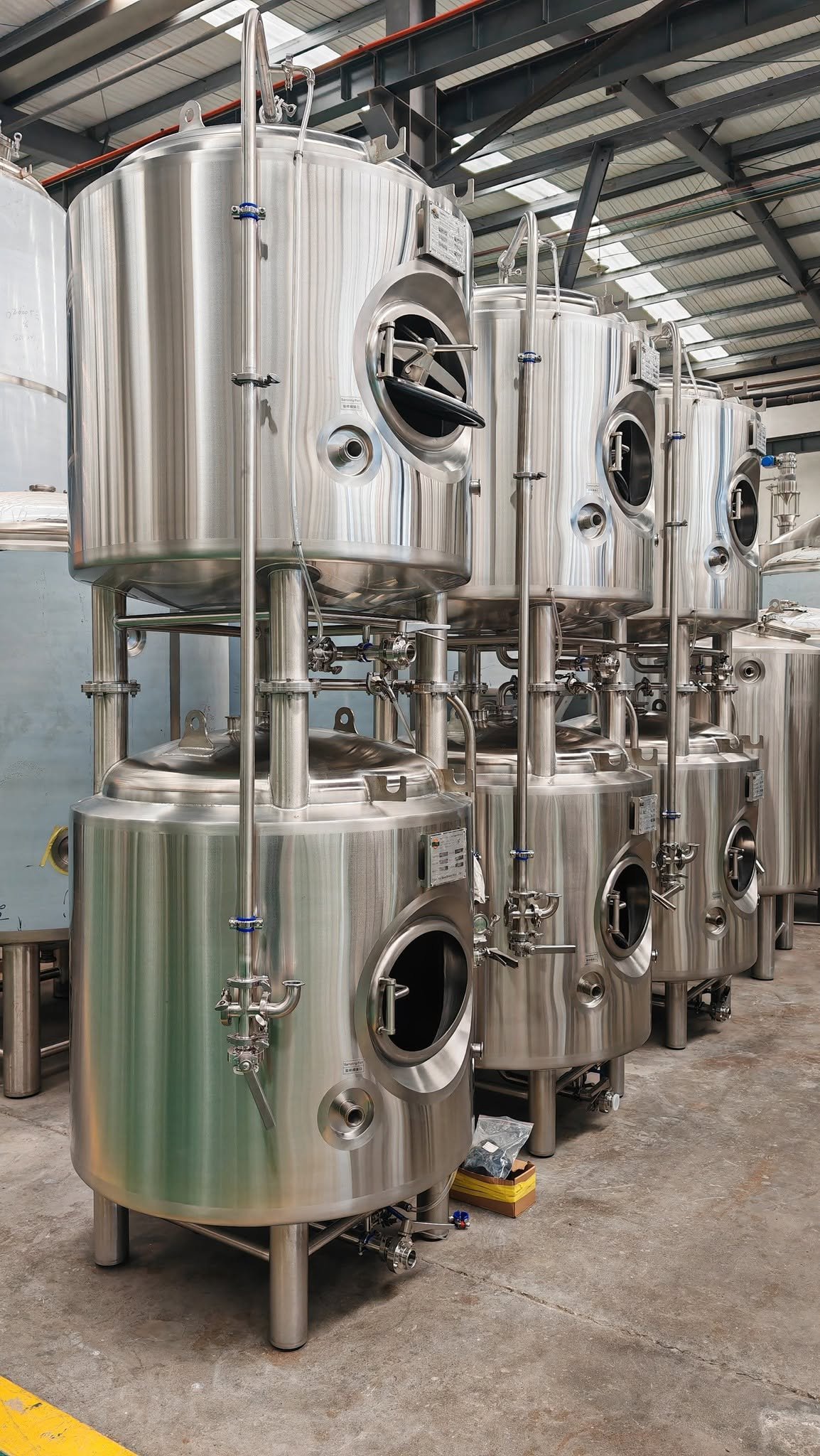
Why Stack Brite Beer Tank?
The main reason is space efficiency.
In a conventional brewery layout, multiple tanks are normally installed side by side. As the number of tanks increases, the required floor area also increases.
A Stacked Brite Beer Tank uses the vertical space of the brewery instead.
For example, instead of using a large floor area to place six tanks side by side, several tanks can be arranged in multiple levels, provided that the building height and structural conditions allow it.
This makes stacked tanks an attractive option for breweries operating in compact buildings.
1. Better Use of Available Floor Space
Floor space is expensive, particularly for urban breweries and brewpubs.
A stacked brite beer tank arrangement can significantly reduce the footprint required for beer storage and serving.
The space saved can then be used for:
- Additional fermentation tanks
- Packaging equipment
- CIP systems
- Raw material storage
- Walkways and operating areas
This allows breweries to make better use of an existing facility without immediately needing a larger building.
2. Increase Beer Storage Capacity
A brewery may want to increase its number of BBTs as production grows, but adding more tanks side by side may not always be possible.
Stacked Brite Beer Tank provides another option.
By utilizing vertical space, breweries can increase their beer storage capacity while keeping the overall floor footprint relatively small.
This can be especially useful when a brewery produces several different beer styles and needs separate tanks for each product.
3. Ideal for Brewpubs and Taprooms
Stacked serving tanks are particularly suitable for brewpubs and taprooms.
These businesses often have limited space but need multiple tanks to serve different beers simultaneously.
For example, one tank can be used for lager, another for IPA, and another for wheat beer. Each tank can be connected to an independent dispensing line.
The stacked arrangement allows more serving tanks to be installed within a compact area.
4. Flexible Brewery Layout
There is no universal brewery layout that works for every project.
The final arrangement depends on building dimensions, ceiling height, equipment capacity, operator workflow, and utility connections.
Stacked Brite Beer Tank give brewery designers another way to optimize the layout.
Instead of thinking only in terms of floor area, engineers can also consider the available vertical space.
However, sufficient clearance must always be provided for inspection, cleaning, maintenance, and safe operation.
5. Keep the Beer at the Right Temperature
Stacked Brite Beer Tank and serving tanks are commonly equipped with cooling jackets and connected to a glycol cooling system.
Maintaining a stable beer temperature is important for carbonation, beer quality, and serving performance.
In a properly designed stacked system, each tank can still have independent temperature control even though the tanks are installed vertically.
The cooling system and glycol piping should be planned together with the tank arrangement to ensure stable and efficient operation.
6. Suitable for Different Production Scales
Stacked Brite Beer Tank systems are not limited to large breweries.
They can be used in:
- Brewpubs
- Taprooms
- Small craft breweries
- Medium-sized breweries
- Commercial beer production facilities
The number and size of tanks can be selected according to production requirements.
For a growing brewery, additional Stacked Brite Beer Tank can also be incorporated into the layout as production capacity increases.
What Should Be Considered Before Installing Stacked Brite Beer Tank?
Although stacking offers clear space-saving advantages, it is not suitable for every building.
Several factors should be evaluated before choosing this configuration.
Building Height
The first consideration is available ceiling height.
There must be enough vertical space for the tanks themselves as well as operating, cleaning, and maintenance access.
Structural Support
The building structure and tank support system must be able to safely carry the combined load of the tanks and beer.
A professionally designed support frame is essential.
Operator Access
Operators need safe access to valves, manways, pressure gauges, carbonation systems, and other components.
Stairs, platforms, guardrails, and working clearances should therefore be considered during the initial brewery layout design.
Cleaning and Maintenance
CIP connections and piping should be designed so that every tank can be cleaned effectively.
Maintenance access is equally important. Saving floor space should never come at the expense of safe operation or convenient maintenance.
Is a Stacked Brite Beer Tank System Right for Your Brewery?
A stacked configuration can be an excellent solution when floor space is limited but additional beer storage or serving capacity is required.
The key is not simply to stack as many tanks as possible. The entire system should be designed around the brewery’s production process, building dimensions, operator workflow, cooling system, and future expansion plans.
For this reason, working with an experienced brewery equipment manufacturer is important when planning a stacked tank layout.
TIANTAI Brewery Equipment Solutions
At TIANTAI, we design customized beer brewing equipment and brewery layouts according to each project’s available space and production requirements.
For breweries with limited floor space, our engineering team can evaluate the possibility of using stacked BBTs or serving tanks while considering structural support, operator access, glycol piping, CIP connections, and future expansion.
Whether you are building a new craft brewery or upgrading an existing taproom, a well-planned stacked tank system can help you make better use of your available space while maintaining an efficient and practical brewing operation.
Email: [email protected]
Edit by Jane