
Carbon dioxide is an important part of beer production. During fermentation, yeast naturally produces a significant amount of CO2 as it converts fermentable sugars into alcohol and other fermentation products. In many breweries, this CO2 is simply released into the atmosphere. At the same time, breweries often need additional CO2 for beer carbonation, tank purging, beer transfer, packaging, and other production processes.
A CO2 Recovery System for Brewery provides a way to recover part of the CO2 generated during fermentation, purify it, store it, and reuse it in the brewery.
This can help breweries reduce their dependence on externally supplied CO2 while making better use of a natural by-product of fermentation.
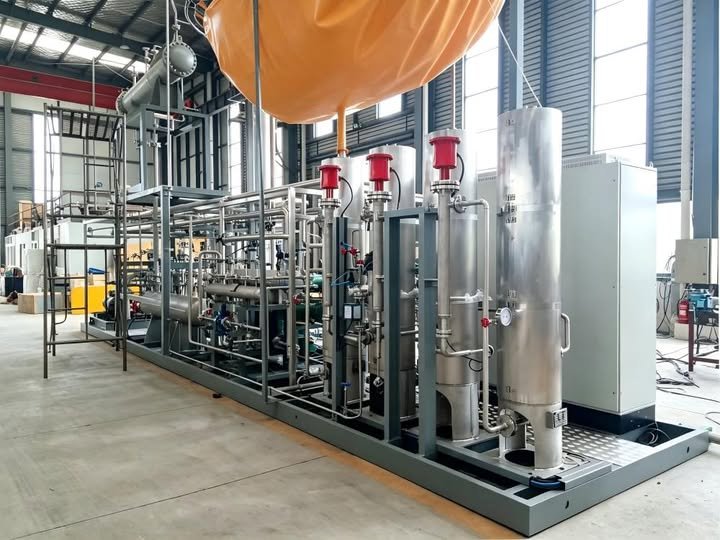
What Is a CO2 Recovery System for Brewery?
A CO2 Recovery System for Brewery is a system designed to collect carbon dioxide produced during beer fermentation and prepare it for reuse.
During fermentation, yeast produces CO2 naturally. Instead of allowing all of this gas to escape through the fermenter’s blow-off system, the recovery system collects the CO2 and sends it through a treatment process.
A typical system may include:
- CO2 collection and recovery equipment
- Gas washing or purification equipment
- Gas drying equipment
- CO2 compressor
- Gas storage tank or balloon
- Safety and pressure control devices
- CO2 monitoring instruments
- Control system
The exact configuration depends on the brewery’s production capacity, fermentation process, CO2 consumption, and required gas purity.
The recovered gas can then be stored and reused in suitable brewery applications.
Why Do Breweries Recover CO2?
The main reason is that fermentation naturally produces CO2 while many brewery operations require CO2.
This creates an opportunity to reuse a gas that would otherwise be lost.
A CO2 Recovery System for Brewery can help reduce the amount of purchased CO2 required for certain applications.
For breweries with high fermentation volumes, the potential benefit can be especially significant because larger fermentation capacity generally means greater CO2 generation.
However, the actual recovery rate depends on factors such as fermentation volume, beer style, fermentation conditions, gas losses, and the brewery’s operating procedures.
1. Reduce Dependence on Purchased CO2
CO2 is commonly used throughout the brewery.
It may be required for carbonation, tank purging, beer transfer, bright beer tank operations, keg filling, canning, bottling, and other processes.
Depending on the location and supply situation, purchasing food-grade CO2 can represent a significant operating cost.
By recovering fermentation CO2, a brewery can produce part of its own CO2 supply.
A CO2 Recovery System for Brewery therefore provides an opportunity to reduce the amount of externally supplied CO2 needed for routine production.
It does not necessarily eliminate the need for purchased CO2, but it can reduce dependence on external supply.
2. Make Better Use of Fermentation CO2
Fermentation naturally generates CO2 as part of the brewing process.
For a brewery producing several batches every week, a considerable amount of CO2 may be generated during fermentation.
Without a recovery system, most of this gas is simply discharged.
A CO2 Recovery System for Brewery allows the brewery to capture this fermentation by-product instead.
The recovered CO2 can then be treated and stored for later use.
This creates a more efficient relationship between fermentation and downstream brewery operations.
3. CO2 for Beer Carbonation
One of the most obvious applications for recovered CO2 is beer carbonation.
After fermentation and maturation, beer may need additional CO2 to achieve the desired carbonation level.
CO2 can be introduced into the beer through a carbonation stone or another suitable carbonation system.
Recovered CO2 can potentially be used for this purpose after it has passed through the required purification and quality-control process.
The final gas quality is important because CO2 comes into direct contact with the beer.
For this reason, breweries should make sure that the recovery system is properly designed for the required food and beverage application.
4. Tank Purging and Beer Transfer
CO2 is also widely used for tank purging.
Before beer is transferred into a bright beer tank, serving tank, keg, or packaging line, breweries may purge the receiving vessel with CO2 to reduce oxygen exposure.
CO2 can also be used during certain beer transfer operations to help move beer through the process system.
Using recovered CO2 for these applications can increase the overall utilization of the gas generated during fermentation.
A CO2 Recovery System for Brewery can therefore be connected to a broader brewery gas distribution system, depending on the plant layout.
5. Supporting Brewery Sustainability
Reducing waste and improving resource efficiency are becoming increasingly important for modern breweries.
Fermentation CO2 is a natural by-product of beer production. Recovering and reusing it can help a brewery make better use of its existing resources.
A CO2 Recovery System for Brewery may therefore form part of a brewery’s wider sustainability strategy.
The environmental benefit depends on the actual amount of CO2 recovered and the amount of externally supplied CO2 that can be replaced.
For larger breweries, the potential impact can be more noticeable because fermentation volumes are higher and CO2 consumption is often greater.
How Does a Brewery CO2 Recovery System Work?
The basic recovery process starts with fermentation.
When fermentation is active, CO2 produced by the yeast leaves the fermenter through the gas outlet. Instead of venting directly to the atmosphere, the gas is directed toward the recovery system.
The gas may first pass through a cleaning or washing stage to remove unwanted particles and contaminants.
It can then be dried and purified before being compressed.
After compression, the recovered CO2 can be stored in a suitable storage vessel until it is required by the brewery.
A control system can monitor pressure, temperature, gas flow, and other operating parameters.
The exact process configuration varies depending on the equipment supplier and the required gas quality.
What Should You Consider When Choosing a CO2 Recovery System?
The recovery system should be designed according to the brewery’s actual production conditions.
Fermentation Capacity
The amount of CO2 available for recovery depends largely on fermentation volume and production frequency.
A brewery should therefore calculate its potential CO2 generation before selecting the system capacity.
CO2 Consumption
The brewery’s own CO2 demand is equally important.
If the brewery uses large amounts of CO2 for carbonation, purging, and packaging, recovering fermentation CO2 may provide greater practical value.
Gas Purity
Recovered fermentation gas is not automatically ready for direct use.
The system should include appropriate purification and treatment stages to achieve the required gas quality for its intended application.
Storage Capacity
The storage tank or gas holder should be sized according to the brewery’s recovery rate and consumption pattern.
If fermentation and CO2 consumption occur at different times, sufficient storage capacity becomes particularly important.
Automation and Safety
CO2 is colorless and odorless and can present a serious safety risk in poorly ventilated areas.
A suitable system should therefore include appropriate pressure controls, safety devices, gas monitoring, ventilation considerations, and control functions.
Is a CO2 Recovery System Suitable for Every Brewery?
Not necessarily.
For a small brewery with limited fermentation capacity and relatively low CO2 consumption, the investment may not always provide a strong economic return.
For medium and large breweries with continuous fermentation activity and significant CO2 demand, however, recovery can become more attractive.
The decision should be based on several factors, including fermentation capacity, CO2 purchasing costs, recovery efficiency, storage requirements, equipment investment, and expected operating savings.
A proper CO2 balance calculation can help determine whether recovery is suitable for a particular brewery.
Customized CO2 Recovery System from TIANTAI
At TIANTAI, we provide customized CO2 Recovery System for Brewery solutions for different brewery capacities and production requirements.
The system can be designed according to fermentation volume, expected CO2 generation, gas consumption, storage capacity, purification requirements, and brewery layout.
A complete solution can be integrated with fermentation tanks, CO2 storage, carbonation equipment, and the brewery’s existing gas distribution system.
Whether you are planning a new brewery or upgrading an existing production facility, our engineering team can help evaluate your fermentation CO2 generation and design a suitable recovery solution.
Email: [email protected]
Edit by Jane