
As breweries increase production, efficiency becomes just as important as beer quality. While much attention is given to the brewhouse, fermentation tanks, and packaging lines, one area that can significantly improve daily operations is Automatic Spent Grain Removal System.
After every brewing cycle, a large amount of wet spent grain remains inside the lauter tun or mash filter. Removing this material manually is labor-intensive, time-consuming, and can interrupt the next brew.
For this reason, many modern beer brewing equipment systems are equipped with an automatic spent grain removal system, helping breweries reduce labor costs and improve production efficiency.
What Is a Spent Grain Removal System?
A spent grain removal system is designed to automatically transport wet spent grain from the brewhouse to a collection point outside the production area.
Instead of using shovels or carts, the brewer simply starts the discharge process after lautering. The grain is moved through a series of mechanical conveyors until it reaches a grain bin, trailer, or collection container.
This solution is widely used in commercial breweries that brew multiple batches each day.
Main Components of an Automatic Spent Grain Removal System
A complete system usually consists of several key components.
1. Lauter Tun Grain Outlet
After lautering is complete, the rakes inside the lauter tun push the spent grain toward the discharge opening.
A hydraulically or pneumatically controlled grain door opens automatically, allowing the grain to leave the vessel smoothly.
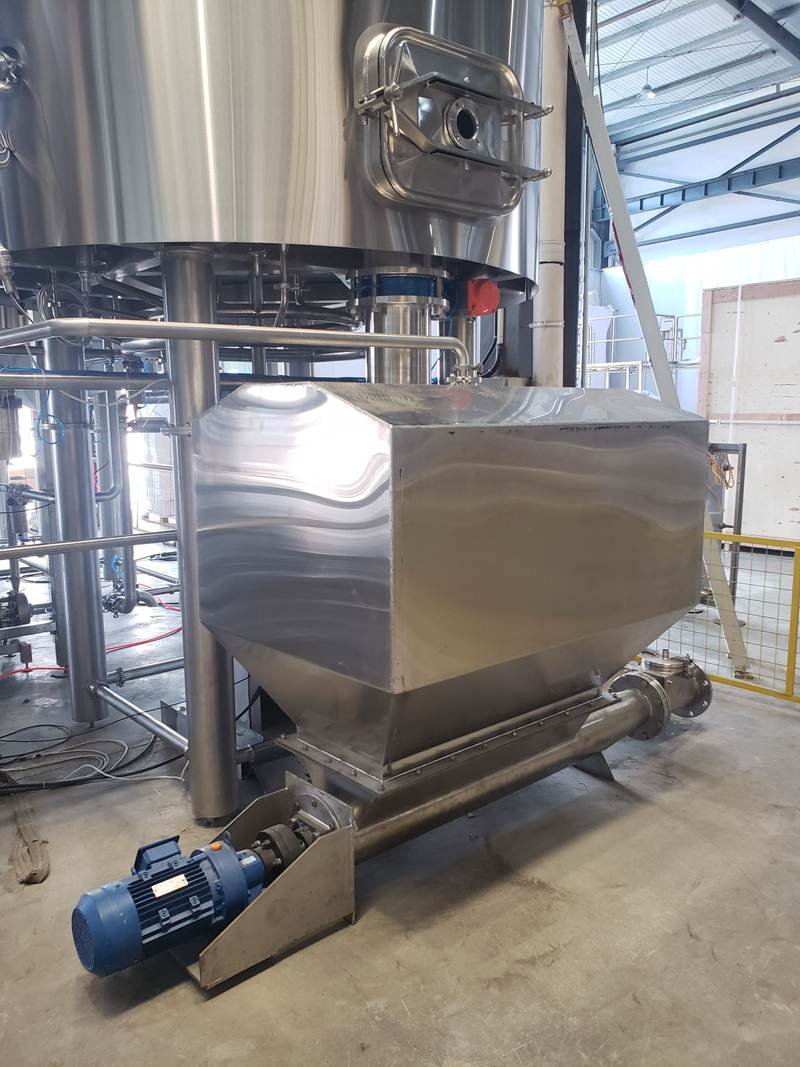
2. Grain Collection Hopper
The discharged grain first enters a stainless steel hopper.
The hopper temporarily stores the wet grain and feeds it evenly into the conveying system, preventing blockages and maintaining a stable discharge rate.
3. Screw Conveyor
The screw conveyor is the most common method of transporting spent grain.
Its advantages include:
- Compact design
- Reliable operation
- Low maintenance
- Suitable for wet grain
- Easy integration into brewery layouts
Depending on the building layout, horizontal, inclined, or vertical screw conveyors can be combined.
4. Grain Collection Bin or Storage Container
The conveyed grain is discharged into a collection bin, trailer, or storage container located outside the brewhouse.
Many breweries sell spent grain as livestock feed or provide it to local farms, making grain handling an important part of daily brewery operations.
Advantages of Automatic Spent Grain Removal System
Compared with manual cleaning, an automatic system offers several important benefits.
Reduce Labor Requirements
Manual grain removal is physically demanding and often requires multiple operators.
Automation greatly reduces labor intensity and allows brewery staff to focus on brewing and quality control.
Shorter Brewing Cycle
Removing spent grain more quickly allows the lauter tun to be cleaned sooner, reducing downtime between brewing cycles.
This is especially valuable for breweries producing multiple batches per day.
Improve Workplace Safety
Wet spent grain is heavy and slippery.
Automatic conveying reduces manual lifting, minimizes workplace injuries, and keeps the brewhouse cleaner.
Improve Brewery Hygiene
A closed conveying system reduces grain spills inside the brewery and helps maintain a cleaner production environment.
This also makes daily cleaning easier.
Which Breweries Need an Automatic Spent Grain Removal System?
Not every brewery requires automation.
For small pilot breweries or brewpubs producing one batch per day, manual grain removal is often sufficient.
However, automatic spent grain handling becomes increasingly valuable for:
- Commercial craft breweries
- Regional breweries
- Industrial brewery projects
- Multi-batch production facilities
- Breweries with limited labor resources
As production capacity increases, the return on investment becomes more significant.
Customized Solutions for Different Brewery Layouts
Every brewery has a unique floor plan, so spent grain handling systems should be designed accordingly.
Engineers typically consider:
- Brewhouse location
- Building dimensions
- Conveyor length
- Elevation changes
- Grain collection position
- Daily production volume
A customized design ensures reliable operation while minimizing installation costs.
TIANTAI Automatic Spent Grain Removal System
At TIANTAI, we provide complete beer brewing equipment solutions, including customized automatic spent grain removal systems for commercial breweries.
Our engineering team can integrate screw conveyors, grain hoppers, discharge systems, and collection bins into your brewhouse layout, creating an efficient and reliable grain handling process.
Whether your brewery produces one batch or multiple batches per day, we can design a solution that matches your production capacity, building layout, and future expansion plans.
If you are planning a new brewery or upgrading your existing brewhouse, contact us to learn more about our customized brewery equipment solutions.
Email: [email protected]
Edit by Jane