
When building a craft brewery, fruit winery or kombucha fermentation workshop, you will face a vital material choice for mash tun, fermentation tanks and bright beer tanks: 304 vs 316L stainless steel brewery tank. Many startup brewers either blindly pay extra for 316L or only select 304 simply to cut costs. Wrong material selection may trigger corrosion problems and raise long-term maintenance costs. Based on rich experience exporting craft beer brewing equipment, we compare the properties and applicable scenarios of these two stainless steel grades, helping you make rational and budget-friendly decisions.
Basic Properties of Two Stainless Steel Grades
304 Stainless Steel
As a widely used food-grade stainless steel, 304 contains balanced chromium and nickel elements. It delivers reliable corrosion resistance against regular water, wort and finished beer, satisfying standard brewing requirements. Advantages: Moderate raw material price, stable supply and mature processing technology. It remains the mainstream material for standard brewery equipment. Disadvantages: Its anti-corrosion performance declines when exposed to highly acidic liquids, saline environments or long-term contact with concentrated acid and alkaline CIP detergents.
316L Stainless Steel
Molybdenum is added to 316L stainless steel on the basis of 304, greatly enhancing resistance to acid, alkali and chloride ion corrosion, with outstanding performance against pitting corrosion. Advantages: Compatible with acidic fermentation liquids, salt-containing solutions and high-concentration CIP cleaning chemicals. Disadvantages: Higher material cost, which will increase the overall quotation of fermentation tanks and complete brewing systems.
Suitable Application Scenarios
304 Stainless Steel Recommended
- Brewhouse system: mash tun, lauter tun, boiling kettle and whirlpool
- Fermentation tanks & bright beer tanks for regular craft beer production
- Standard piping, valves and plate heat exchangers for beer brewing
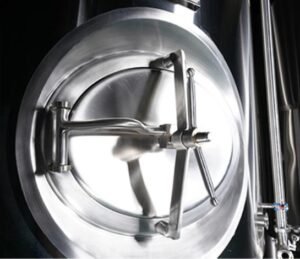
This material fits craft breweries and brewpubs focusing on beer production, with standardized CIP cleaning procedures and no long-term storage of highly acidic raw materials.
Upgrade to 316L Stainless Steel If You Meet The Following Conditions
- Equipment requiring frequent high-strength acid-alkaline cleaning or long-term storage of acidic liquid
- Breweries located in coastal areas with high chloride levels in the air
Common Misconceptions Among Brewers
Myth 1: All brewing equipment must use 316L to meet food safety standards.
Fact: 304 is internationally recognized food-grade stainless steel. It is fully compliant for regular beer brewing, so there is no need to overspend on unnecessary 316L stainless steel fermenters.
Myth 2: 304 tanks rust easily.
Fact: With proper brewing operation and standardized CIP cleaning, well-maintained 304 tanks can serve for more than a decade. Rust is usually caused by residual cleaning agents, prolonged soaking in acid/alkali liquid or excessive chloride in water, rather than inherent defects of the material itself.
Myth 3: Only sour beer fermenters need to be 316L.
Fact: If acidic wort circulates through pipelines, all piping in contact with acidic media should adopt matching materials to avoid pipeline corrosion in advance.
Material Selection Advice from Tiantai Brewery Equipment
- Pure craft beer projects: Standardize 304 stainless steel for the whole brewhouse and fermentation tanks to achieve optimal cost performance.
- Production covering fruit wine, kombucha and sour beer: Upgrade the fermentation unit to 316L while keeping the brewhouse in 304 to balance cost and durability.
- Coastal breweries and large-scale production plants: Selectively upgrade equipment contacting acidic substances according to your beverage varieties.
Final Note
Every brewery differs in beverage categories, site conditions and production capacity planning. If you are confused about material matching for your stainless steel fermentation tank, feel free to contact us. The technical team of Tiantai will provide customized stainless steel tank configuration solutions and detailed quotations based on your brewing plan.