
Even with the same brewhouse setup, some breweries maintain consistent wort specifications across batches, with steady gravity, colour and flavour profiles. Others stick to the exact same malt, hops and yeast recipe, yet get inconsistent results — unexpected bitterness or low brewhouse yield appear from batch to batch.
Many brewers spend plenty of time adjusting mash agitator speed, lauter rake timing and boiling duration, while the root cause lies in hot water supply, which is easily overlooked. The hot water tank stabilizes water temperature, regulates water supply and collects waste heat, serving as a reliable foundation for the whole mashing process.
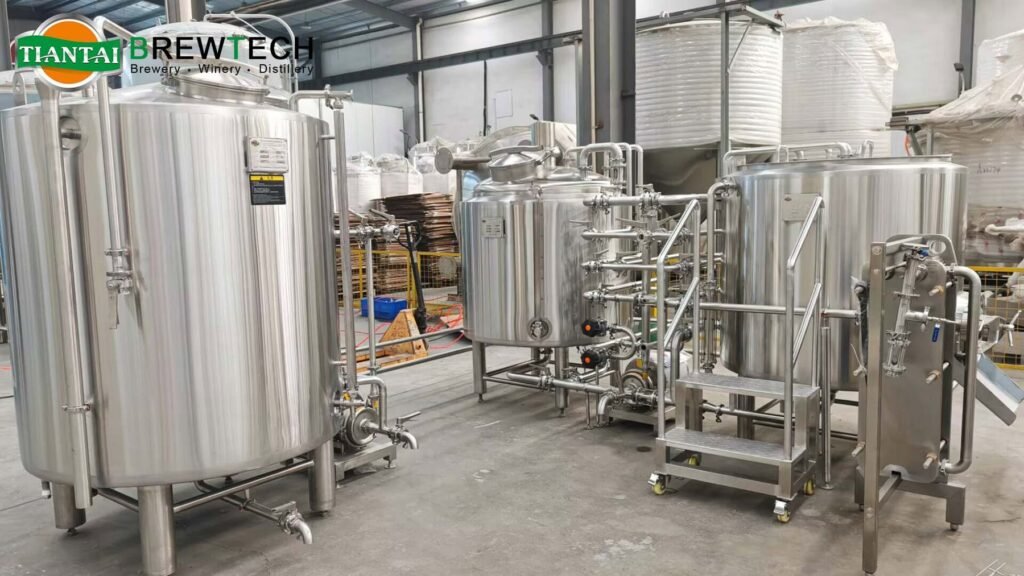
Constant Temperature Water Storage for Stable Brewing
Mashing in, protein rest and sparging require hot water at different target temperatures. Without an independent hot water tank, heating cold water inline struggles to keep up with brewing demand, and temperature fluctuates frequently. This issue becomes more obvious when running multiple brews per day with concentrated water demand.
The hot water tank preheats water to target temperature and holds heat steadily with insulation. Hot water is ready instantly for each brewing step, so you do not need to pause production waiting for water heating. Stable water temperature keeps amylase in malt within the optimal activity range, ensuring predictable sugar conversion and consistent wort gravity. It protects flavour consistency from one batch to the next.
Stable Sparging Water for Better Wort Quality & Higher Yield
Sparging decides both sugar recovery and wort flavour. The temperature and flow rate of sparging water control how sugar is washed out from grain bed, as well as the dissolution of tannins and polyphenols from malt husks. Without buffering from a hot water tank, sparging temperature drifts easily. Too high temperature extracts excessive tannins and brings harsh, lingering bitterness to wort.
Too low temperature slows down sugar dissolution, leaving plenty of fermentable sugar in spent grains, wasting raw materials and raising production costs. A hot water tank delivers sparging water with stable temperature and even flow. Combined with valve control, water penetrates the grain bed gently to recover sugar fully, while limiting harsh tannin extraction. It balances high yield and clean, soft wort flavour.
Waste Heat Recovery to Cut Long-term Operating Costs
Brewing is energy-intensive. The kettle releases massive steam during boiling, and hot wort also releases abundant heat during cooling. The hot water tank acts as thermal storage for the heat recovery loop of the brewhouse. Recovered heat from kettle vapour and wort plate heat exchanger can preheat water stored in the tank, instead of heating cold water from scratch with steam every brew cycle.
Heat is stored and reused for the next batch, greatly cutting steam consumption. For breweries running multiple brews daily, the energy saving is remarkable. This is why most commercial breweries treat hot water tank as standard equipment; the savings on energy over time can cover the equipment investment.
Sanitary Construction to Reduce Contamination Risk
Brewing hot water must meet food-grade standards. Dead corners, stagnant water or condensation on the tank surface will lead to microbial growth, which can enter wort and ruin an entire batch. Professional hot water tanks are manufactured from food-grade SUS304 stainless steel. The inner surface is sanitary polished with smooth welded seams to avoid dirt accumulation. Outer insulation prevents condensation caused by temperature difference, reducing humid environments for bacteria growth. CIP ports are reserved for integrated cleaning.
The tank can go through acid cleaning, alkaline cleaning and hot water sanitization together with other brewhouse vessels, without manual disassembly. It supports reliable sanitation and lowers contamination risk. Tanks are equipped with temperature transmitters, level sensors and safety relief valves. Brewers can monitor water level and temperature on control panels, which supports process logging and traceability.
Flexible Sizing for Different Brewery Scales
Hot water tanks should be matched to brewhouse capacity and daily brew frequency, bigger is not always better. Small craft breweries with limited brew runs can choose compact hot water tanks. They save floor space and meet basic water demand for mashing and sparging. Medium and large breweries running two or more brews each day rely heavily on the tank’s buffering and heat storage function.
Without this tank, production will be interrupted repeatedly while waiting for water heating, slowing down brewhouse turnover. For breweries planning future expansion, hot water tanks can be pre-fitted with extra ports to connect heat recovery units and automatic water supply systems, supporting later automation upgrades.
Most attention goes to the main brewhouse vessels, yet unstable water supply creates a chain reaction on brewing performance. The hot water tank does not take part in mashing, boiling or lautering directly, but it stabilizes temperature, recovers waste heat and guarantees clean process water. For consistent batches and lower raw material & energy cost, a well-designed sanitary hot water tank is a cost-effective addition to any brewhouse.