
A dry hopping doser, also called a hop doser, is a sealed pressure vessel used for closed dry hopping. The bottom butterfly valve is connected with the dry hopping port on top. The dry hopping process does not release the pressure, which minimizes the impact on the original beer, and can also effectively reduce the hygienic risk.
Unlike a hop gun, it does not need a diaphragm pump or centrifugal pump. Its job is simple: get hops into the fermenter without opening the manhole, so no oxygen gets in and no beer splashes out.
Dry Hopping Doser by Tiantai:
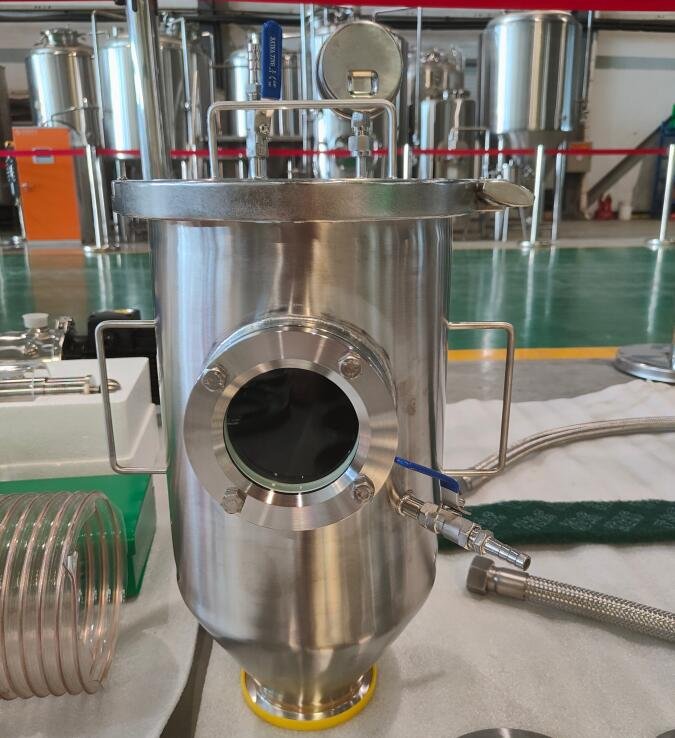
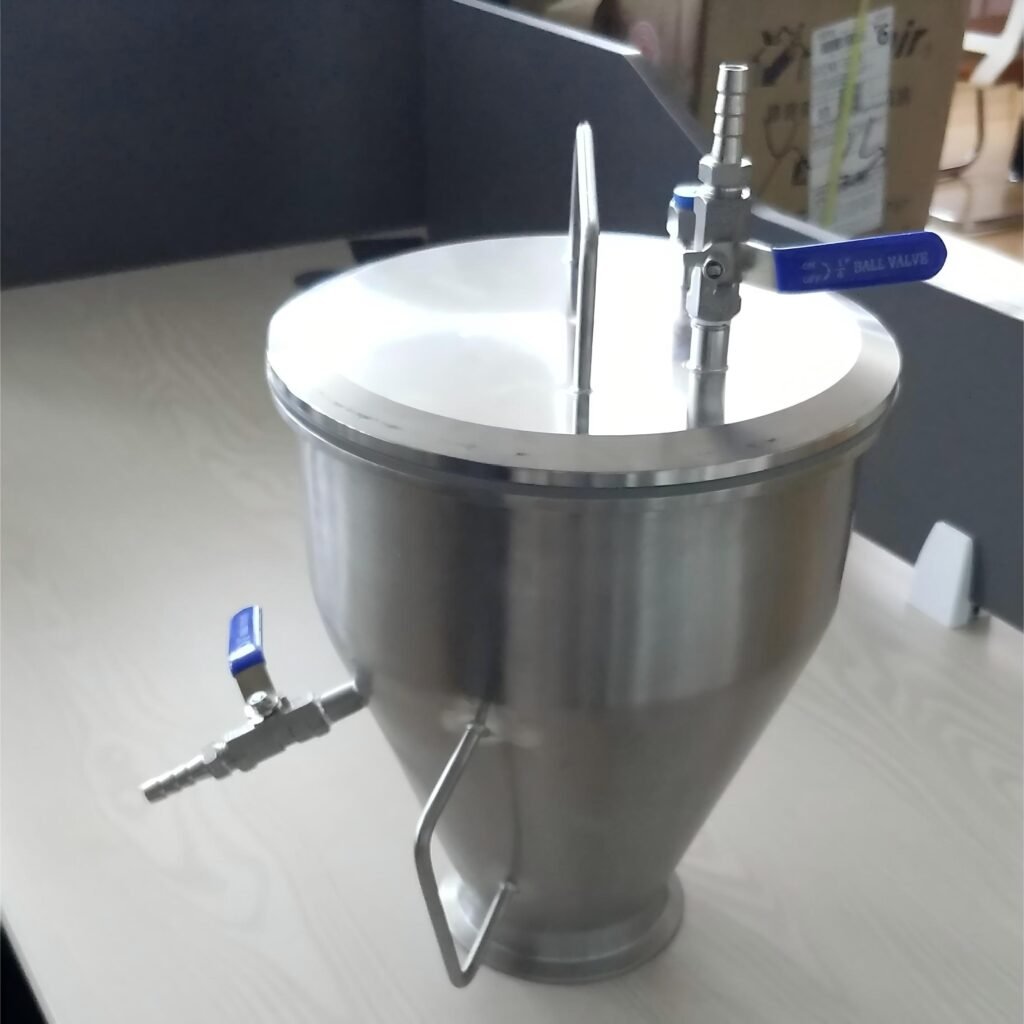
Model:
2L 5L 10L 15L
Components:
- Tank
- Air Injection Port
- Venting Valve
- Pressure Guage
- Sight Glass (Optional)
Where Does the Dry Hopping Doser Come From?
Dry hopping is an old technique. It started with British cask ale, where brewers dropped hops straight into wooden casks to add aroma and help preservation.
Then the American craft‑beer boom happened. IPA and hazy NEIPA became hugely popular, and brewers started using much larger hop dosages. That is when the old way of dry hopping became a real problem.
Back then, almost every small brewery did it the same way:
- Release pressure from the fermenter.
- Open the manhole.
- Pour hops in by hand.
It was messy. As soon as the lid opened, CO₂ rushed out and created a “hop volcano” — beer and hops splashed everywhere, wasting product and dirtying the brewery.
Even worse, fresh air flooded into the tank. Hop‑forward beer is extremely sensitive to oxygen. Once oxidized, the bright citrus and tropical fruit aroma disappears fast, and the beer develops a stale, cardboard‑like off‑flavor. A whole batch could be ruined. Open manholes also raised the risk of bacteria contamination.
A hop gun solves these problems, but it needs an extra pump — more cost for many small and mid‑size breweries. A lot of brewers only wanted one thing: a simple, low‑cost way to add hops without opening the tank.
That is how the dry hopping doser (hop doser) was invented.
The idea is very simple. It is a separate pressure‑resistant vessel. You load hops inside first, then use CO₂ to purge all the oxygen out. After connecting it to the fermenter, a small pressure difference pushes the hops into the tank. No manhole opening. No circulation pump. No oxygen. No hop volcano.
It does not offer fast circulating extraction like a hop gun. Aroma extraction happens through long static soaking inside the fermenter. Its core value is low‑cost closed hop dosing.
For this reason, the dry hopping doser and the hop gun remain two mainstream closed dry‑hopping solutions — each one fits different brewery budgets and production habits.
Core Functions
1. Closed pressure dosing to reduce oxidation
CO₂ purges all air from the dry hopping doser before dosing. The whole process runs sealed. No manhole opening means less oxygen contact, so the fresh hop aroma stays alive longer and the beer ages more slowly.
2. No more “hop volcano” overflow
The fermenter stays under positive pressure the whole time. There is no pressure release and no lid opening, so CO₂ cannot rush out and splash beer or hops. Less waste, cleaner brewery, safer operation.
3. Simple system, no circulation pump needed
You only need a CO₂ supply. No extra pump, fewer pipes, lower cost to retrofit existing fermenters, and easier operation for new staff.
How It Works — Step by Step
- Load hops (pellet or whole cone) into the dry‑hopping doser and seal the top lid.
- Connect the dry hopping doser to the dry‑hop port on top of the fermenter and tighten the clamp.
- Purge with CO₂ several times to remove all oxygen inside.
- Set the dry hopping doser pressure slightly higher than the fermenter pressure.
- Slowly open the bottom butterfly valve. Hops fall into the fermenter by pressure difference and gravity.
- After dosing, close the valve, release pressure from the dry‑hopping doser, disconnect it, and run CIP cleaning for next use.
Advantages
- No circulation pump needed — lower equipment cost
- Easy to learn and operate
- Closed process prevents oxidation and hop splash
- Works with both pellet hops and whole cone hops
Disadvantages
- All hops go inside the fermenter, so a lot of hop residue builds up at the bottom — heavier CIP workload and more cleaning chemicals
- Aroma extraction relies on static soaking, so it takes longer — usually 2 to 5days
- Hop utilization rate is moderate; for the same hop amount, extraction efficiency is lower than a circulating hop gun
- The fermenter must have a dedicated dry hop port; without one, you cannot use the dry hopping doser
The dry hopping doser was born to solve two classic headaches of traditional open dry hopping: oxygen pickup and hop volcano overflow. It offers a simple, pump‑free, low‑cost way to dose hops under sealed pressure. It is not as fast as a hop gun, and it leaves more residue in the fermenter, but for breweries that want reliable closed dry hopping on a budget, it is a very practical choice.