
When planning a new brewery project, many brewers struggle with one key decision: install conical fermenters inside a temperature-controlled workshop or build an outdoor tank farm. Neither solution fits every brewery. The final choice depends on production capacity, site conditions, local climate, construction budget and your requirements for consistent beer flavor.
Indoor Conical Fermenters
Indoor conical fermenters are placed in a constant-temperature workshop, greatly reducing disturbance from sunlight and day-night temperature fluctuation. The tank is supported by legs, and the cone angle is normally 60–75 degrees for yeast settling and harvesting. Separate glycol jackets are equipped on cylinder and cone sections for independent zone temperature control. With PU insulation, the tank interior is finished with sanitary high-precision polishing. PVRV safety and vacuum valves, together with hydraulic shock pressure gauges, are mounted on tank top to keep pressure safe.
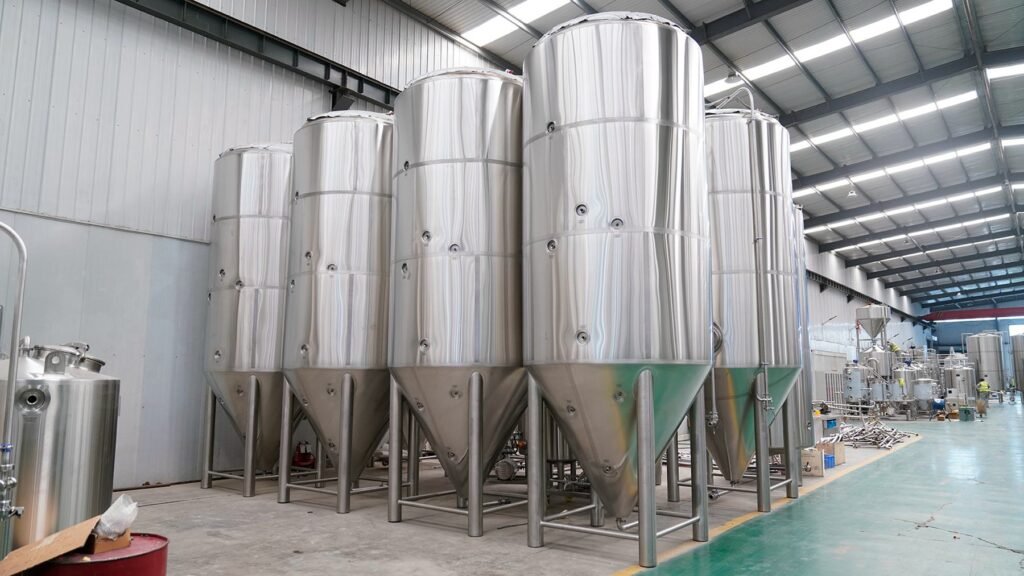
Advantages Convenient for routine inspection, sampling, CIP cleaning and yeast harvesting. Flexible tank layout. The enclosed workshop helps maintain hygiene and reduce contamination risks. Stable temperature keeps yeast fermentation and diacetyl reduction consistent, delivering uniform flavor batch by batch. It works especially well for lager beer which is sensitive to temperature changes.
Limitations Extra indoor space must be reserved. Tall conical tanks require high workshop ceiling and strong floor load capacity, which limits the maximum volume of single tank. Multiple running tanks release fermentation heat continuously, so ventilation is required, leading to higher civil construction cost.
Outdoor Conical Fermenters
Outdoor conical fermenters work under harsh conditions. Tanks are exposed to strong sunlight, severe cold, wind, frost, rain and snow, so the whole design needs upgrading. Thicker insulation layer is adopted, covered with aluminum alloy or stainless steel corrugated cladding. It stops rainwater from seeping into insulation and prevents cold loss. The structure uses large-section support legs plus ring beam for stronger anti-overturn performance. For cold regions, tank top breather valves should be all-weather freeze-resistant type, capable of withstanding temperature down to -40℃. Cooling jackets, pressure protection and sanitary polishing are also equipped to meet fermentation requirements.
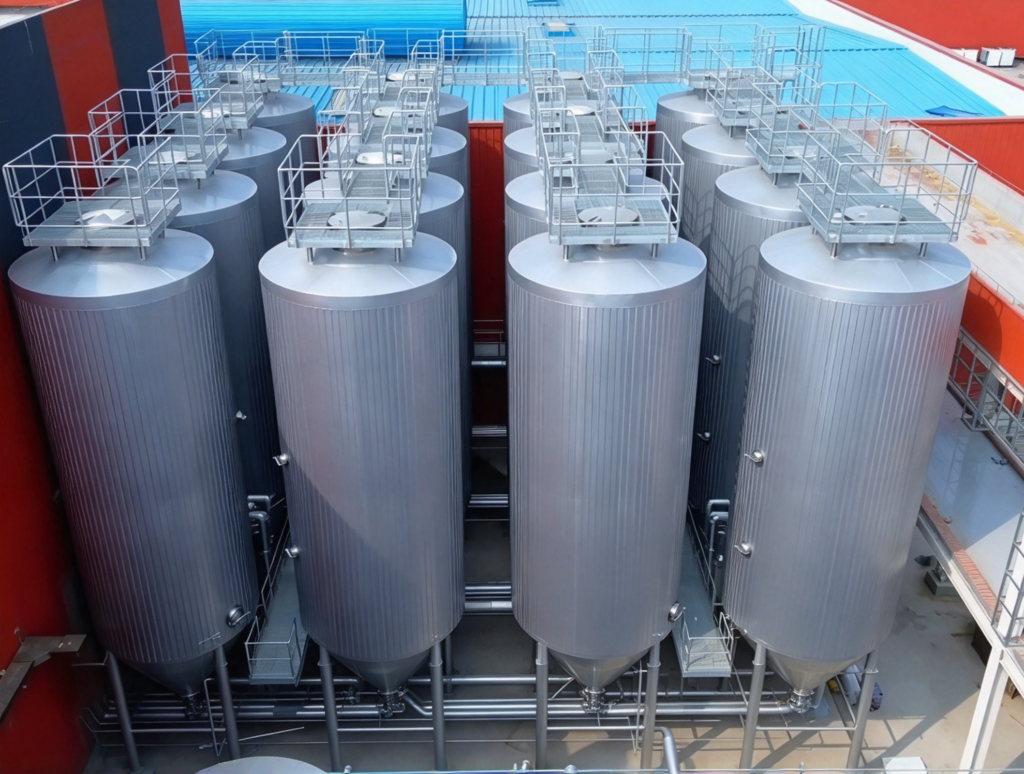
Advantages No tall building is required, which greatly cuts civil engineering investment. Tank farm expansion is simple, new tanks can be added gradually. Fermentation heat dissipates naturally into ambient air, no extra workshop ventilation system needed. It is widely used for large commercial breweries.
Disadvantages Higher manufacturing cost. Direct sunlight in summer increases glycol cooling load. Pipe and valve freeze protection is required in cold areas. Inspection and maintenance become difficult in bad weather. Outer cladding ages over time, regular inspection for insulation water leakage is necessary.
Selection Guide
- Small & medium craft breweries with premium small-batch beer: Choose indoor fermenters for stable flavor and easy daily operation.
- Large commercial breweries with long-term expansion plans: Choose outdoor tank farm to save building cost.
- Regions with huge day-night temperature difference, hot summer or freezing winter: Indoor layout is preferred. If outdoor installation is required, upgrade thick insulation, waterproof cladding and reinforced foundation, and use freeze-resistant valves for cold climates.
- Sufficient workshop space but limited building budget: Indoor tanks. Ample land, tight civil budget and future expansion plan: Outdoor tank farm.
Final Notes
Both indoor and outdoor conical fermenters should be equipped with glycol cooling jackets, PVRV safety & vacuum valves, hydraulic shock pressure gauges and CIP ports. For outdoor tanks, pay attention to waterproof insulation, wind and snow load of foundation. For indoor tanks, calculate ceiling height, floor bearing capacity and workshop ventilation in advance.