
Mashing is the core stage of craft beer brewing. The conversion of starch inside malt into fermentable sugar relies on various natural enzymes from malt. Many brewers focus heavily on mashing temperature, yet they often overlook pH value. In fact, pH level directly affects enzyme activity, wort flavor and the smoothness of subsequent lautering. Tiantai mash tun supports automatic temperature curve control for mashing and optional online pH monitoring module, helping breweries steadily manage the whole mashing process.
How pH Affects Enzyme Activity in Mashing
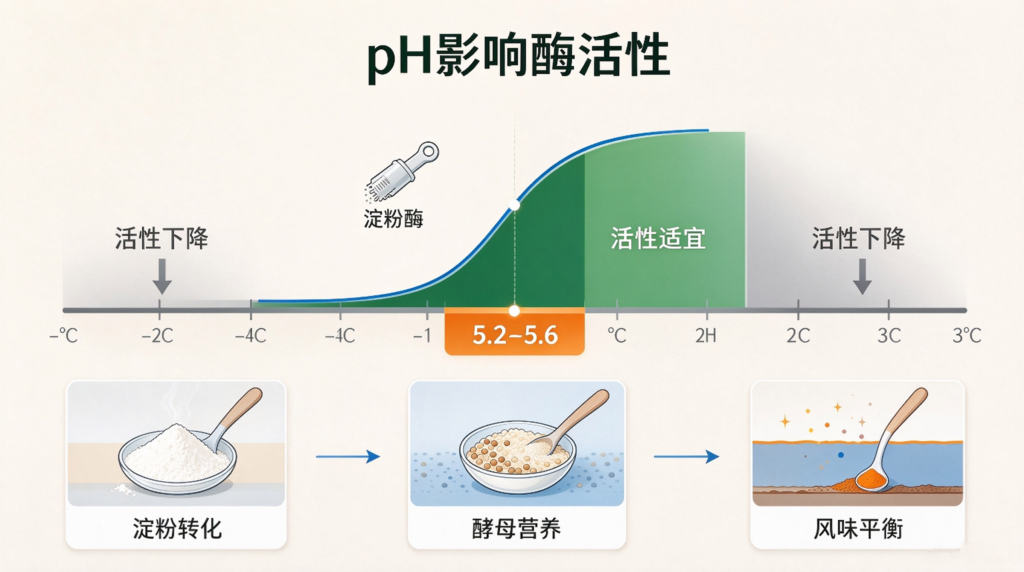
Amylases from malt are the main workhorses of mashing. Every type of enzyme works best within its proper pH range. When mashing pH stays in the ideal range, amylase activity reaches peak performance. Starch can be efficiently broken down to produce enough fermentable sugar. This ensures stable alcohol content after fermentation. If pH gets too high or too low, enzyme activity drops sharply. With the same mashing time, incomplete starch conversion leads to insufficient sugar in wort. The final beer will have weak fermentation and thin body, lowering production yield. Besides amylase, proteases are also sensitive to pH. Proper pH allows moderate breakdown of malt protein to supply nutrients for yeast. Unbalanced pH causes over or insufficient protein decomposition, creating hidden quality risks.
How pH Impacts Wort and Beer Flavor
The pH value set during mashing will carry through to the finished beer. Too high pH darkens wort color and brings rough, harsh bitterness, resulting in heavy and unsmooth beer taste. Too low pH slows down mashing reactions and creates sharp sour notes, ruining the balanced flavor profile of beer. A stable pH environment reduces the formation of unwanted flavor compounds. It well preserves the natural sweet aroma from malt, delivering clean, soft beer taste and consistent quality batch by batch.
Influence of pH on Wort Lautering
Lautering comes right after mashing, and pH plays an important role in this step. Optimal pH helps malt husks build a stable filter bed for fast and smooth wort flow. When pH goes out of the target range, protein and polyphenols tend to precipitate abnormally. The filter bed turns sticky and gets blocked. Extended lautering slows down the whole production line and raises the risk of wort oxidation, hurting beer stability. Good pH control prevents blockage during filtration and reduces unexpected production downtime.
Stabilize Mashing pH: Solutions from Tiantai Mash Tun
Water quality and malt variety will change the pH condition in mashing system. Manual sampling test has obvious time lag, making real-time monitoring difficult. Tiantai mash tun comes with complete process support. It realizes automatic temperature curve control and storage of multiple mashing recipes. Online pH monitoring device is available as an option. Real-time pH data can be tracked throughout mashing for timely adjustment. Equipped with variable-frequency mashing impellers, the equipment mixes materials evenly to maintain uniform pH inside the tank and avoid local uneven acidity and alkalinity. Custom glass manholes allow operators to observe mashing status conveniently.
Invisible but vital, mashing pH greatly impacts sugar extraction efficiency, beer flavor and lautering performance. Both temperature and pH control are essential for stable mass production. With mash tun equipped with pH monitoring function and stable process parameters, breweries can consistently produce high-quality craft beer with reliable taste.