
Beer cannot be sent for filling straight after primary fermentation. Freshly fermented beer still contains suspended yeast cells, protein particles and polyphenol complexes, and its flavour profile remains unstable. Cold storage, also known as cold conditioning, mostly takes place in bright beer tanks. It acts as a critical link between fermentation and packaging, strongly affecting beer clarity, smoothness and shelf stability.
Low temperature forms the foundation of cold conditioning. The bright beer tank holds beer at a chilled temperature. Cold conditions reduce the solubility of many substances inside the beer. Tiny suspended particles that stay afloat at warmer temperatures gradually lose buoyancy and sink under gravity. These particles include residual yeast, cold break, and protein-polyphenol flocs. They are too fine to settle completely during primary fermentation. Cold storage gives them enough time to aggregate into larger clumps and settle toward the tank bottom. After cold conditioning, the upper beer becomes bright and clear, and haze will not develop quickly once packaged.
On the sensory side, cold storage rounds out the beer flavour. Primary fermentation creates many immature by-products, diacetyl being the most notable one. Diacetyl brings unwanted butter or butterscotch off-flavours. Under suitable cold conditions, remaining viable yeast continues slow metabolism and breaks down diacetyl. Once diacetyl is eliminated, harsh, green flavours fade away. Malt sweetness and hop aroma come forward, while bitterness turns clean and mellow. This is the core flavour maturation stage.
In addition, low temperature suppresses yeast and microbial activity. At warmer temperatures, leftover yeast may restart active fermentation, generating extra CO₂ and unwanted metabolites. This leads to uncontrolled secondary fermentation in finished packages, over-carbonation and even bottle bursting. Cold conditions slow yeast down and stop fermentation reliably. Harmful bacteria also struggle to multiply at low temperatures, lowering the risk of souring and spoilage and extending shelf life.
Carbonation stabilisation happens inside the bright beer tank at the same time. Proper carbonation delivers fine, persistent foam. Carbon dioxide dissolves much better in cold liquid. With controlled head pressure inside the sealed bright beer tank, CO₂ dissolves evenly into the beer, ensuring consistent carbonation for the final product.
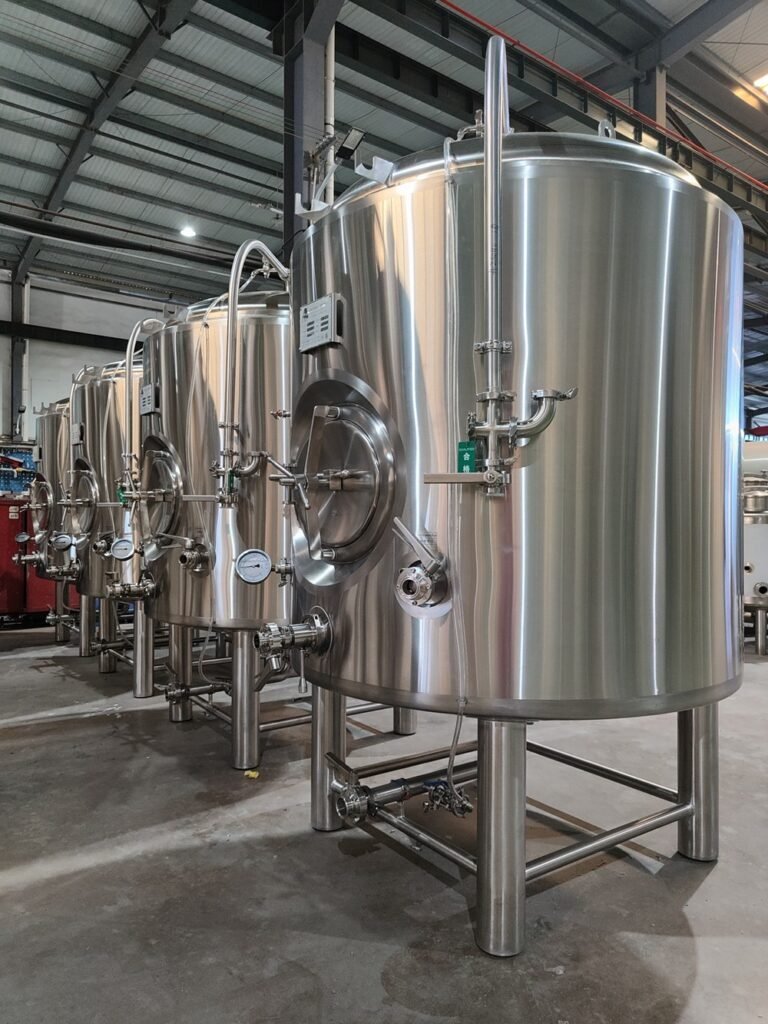
Sealed, pressure-resistant construction of bright beer tanks is essential throughout this process. The tank stays fully closed to block oxygen intake. Oxygen is one of beer’s biggest enemies, triggering stale cardboard notes and rapid flavour deterioration. The pressurised sealed environment maintains carbonation and minimises oxygen exposure, protecting the carefully developed flavour. Sediment and yeast settled at the tank bottom can be drained periodically to avoid off-flavours leaching back into the bulk beer.
Cold storage is not a case of “the longer the better”. Temperature and holding time must match the beer style. Lager beers generally require longer cold conditioning cycles, while many ale styles need shorter cold storage. Excessively low temperature brings risks such as ice formation and higher liquid viscosity, which complicates filtration and filling.
To sum up, cold storage is far more than simply cooling beer. Inside the sealed bright beer tank under chilled conditions, particle sedimentation, diacetyl reduction, flavour maturation, carbonation and oxygen control progress together. Only after cold conditioning can beer gain brilliant clarity, smooth taste and reliable shelf stability.