
Recently, we completed a 300L whisky distillation system at Tiantai Factory, mainly designed for single malt whisky production. Here, we are happy to introduce this project to you and hope it can give you some ideas for your own distillery project. 🙂
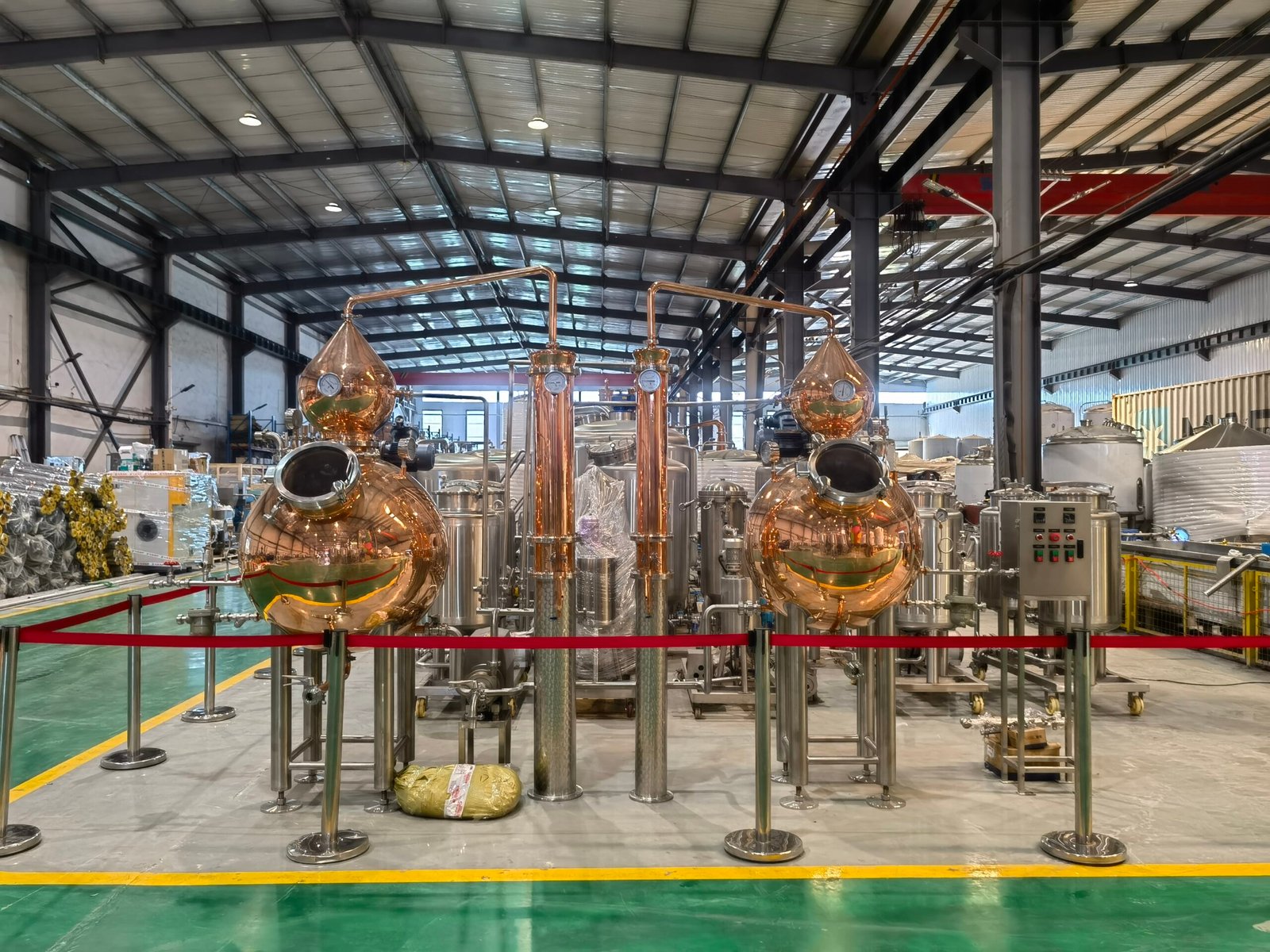
1. Why Does a Single Malt Whisky Distillation System Use Two Different-Sized Stills?
Whisky production usually involves two distillation stages, which is why two stills of different sizes are commonly used.
In a typical double-distillation process, the larger still is called the Wash Still, while the smaller one is called the Spirit Still. The smaller still is often around 60% of the capacity of the larger still, although the exact ratio can vary depending on the distillery’s production requirements.
The whisky-making process generally includes the following steps:
First Distillation (Wash Distillation)
The first distillation takes place in the larger still, known as the Wash Still. Its purpose is to distill the fermented liquid (wash) and separate the alcohol-containing liquid, known as low wines.
The resulting low wines have a higher alcohol concentration than the original wash but still contain various compounds that require further separation.
Second Distillation (Spirit Distillation)
The low wines are transferred to the smaller still, known as the Spirit Still, for the second distillation.
During this stage, the distiller carefully separates the foreshots, hearts, and feints. The heart cut is collected as the desired spirit, helping achieve the target alcohol strength, aroma, and flavor profile.
2. Advantages of a Double-Pot Whisky Distillation System
Operational Efficiency
Using two stills with different capacities allows each distillation stage to operate according to its specific requirements. The smaller still generally requires less time and energy to heat up and cool down, helping improve operational flexibility.
Alcohol Quality and Taste
The two-stage distillation process allows distillers to control the distillation conditions and make precise cuts at different stages.
During the second distillation, the separation of foreshots, hearts, and feints plays an important role in determining the final spirit’s quality, aroma, and flavor.
Separate Distillation Stages
The larger Wash Still is used for the first distillation, while the smaller Spirit Still is used for the second distillation.
This arrangement allows each still to perform its specific function and helps maintain a consistent production process.
Aroma and Flavor Development
The shape and size of the still, heating method, distillation speed, and cut points all influence the final whisky’s character.
With two different-sized stills, distillers can adjust the operating conditions of each stage to develop the desired aroma and flavor profile.
3. Customized Single Malt Whisky Distillation Equipment by Tiantai
At Tiantai, we manufacture customized copper and stainless steel distillation equipment for whisky, brandy, gin, vodka, and other spirits.
Whether you are planning a small craft distillery or a commercial whisky production facility, we can customize the still capacity, configuration, heating method, and auxiliary equipment according to your production requirements.
Planning your own whisky distillery? Contact Tiantai to discuss your project and explore a suitable distillation solution!
👤 Cassie
📧 [email protected]